Inhabit
Phone video. A world to move through.
Reconstructing rooms for robot simulation.
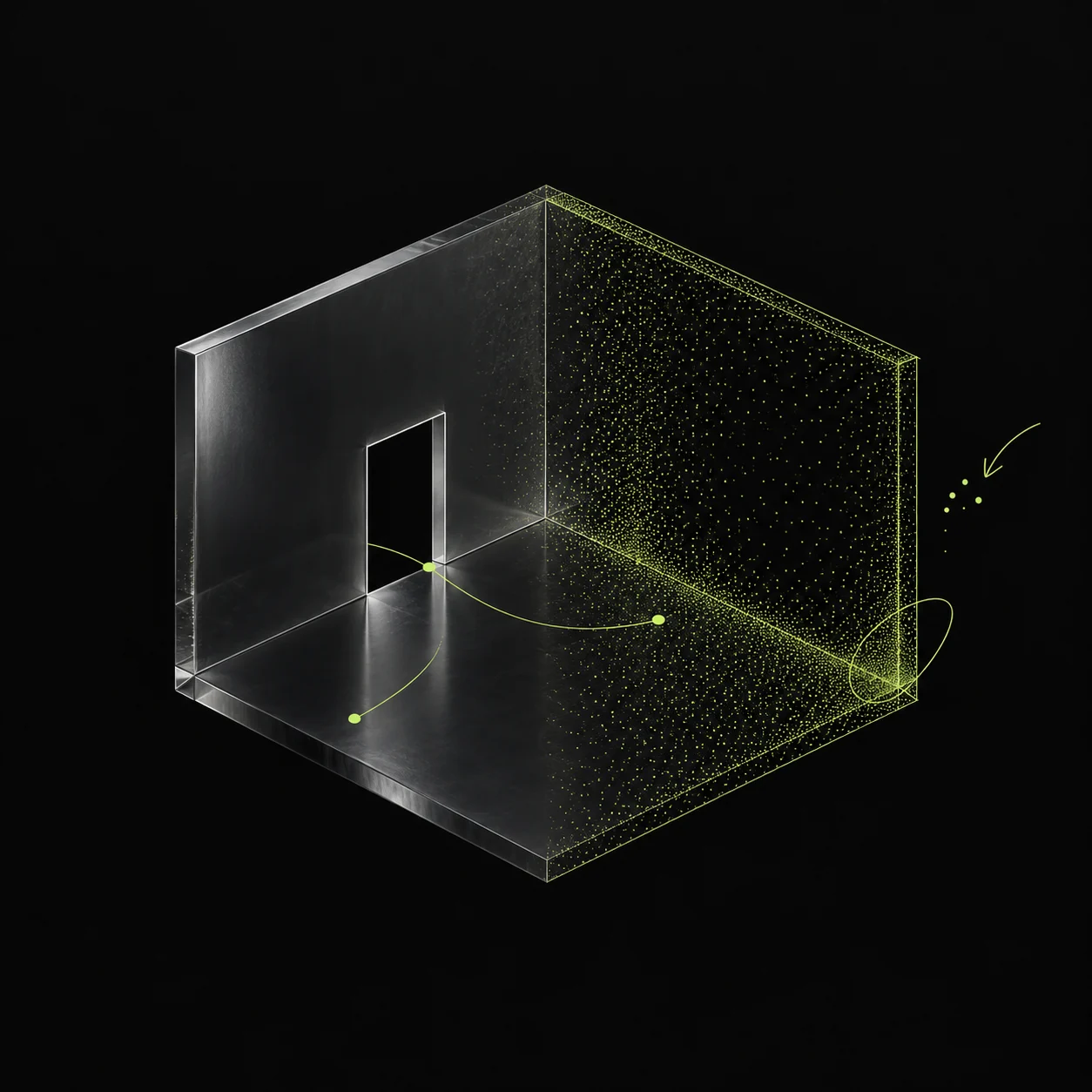
I’m building Inhabit to turn phone video into scenes for robot simulation. I test the reconstructed geometry against reference scans and in a physics engine.
- 01 / Capture
Phone video
- 02 / Reconstruct
Keep the backbone.
Fill the gaps. - 03 / Test
Navigation &
physical contact
From video to simulation.
The pipeline takes phone video, reconstructs a room, and exports a scene for navigation and physics simulation. I check whether the resulting scene can support navigation and physical contact.
Combining reconstructions.
Different reconstruction methods leave different gaps. Inhabit combines Gaussian-splatting and signed-distance-field approaches: it keeps a backbone reconstruction and fills missing regions from the others, rather than averaging all their surfaces.
That means accepting a small loss in measured accuracy in exchange for more complete geometry.
What I test.
Geometry is compared with reference scans, then used for navigation in Habitat-Sim and physics tests in Genesis. The experiments include a simulated quadruped standing on a reconstructed floor.
This is research in simulation. It doesn’t establish that a physical robot can safely navigate the same room.